
3d. The Design Advisory Group (DAG)
About The Design Advisory Group (DAG)
The Design Advisory Group (DAG) for the future Anti Racism Observatory for Scotland was invited by the Minister for Equalities to support strategic and operational work during an interim phase from December 2023 to December 2024.
Purpose
The agreed focus was twofold:
- Find and commission an appropriate “fiscal host” organisation that could administrate, in this short timescale, an anti-racism community fund and also enable the recruitment of a range of short-term freelance staff to undertake inception work supporting the future AROS.
- To create and support rolling out a national anti-racism community engagement fund, built with anti-racism principles and practices, in order to engage with people across Scotland who experience racism.(DAG, 2024a)
The DAG programme is a body of preparatory work which collates the thinking of the AIGG and the DAG into policies and processes ready for AROS inception (DAG, 2024f)
The intention was to hear from others and create shared understanding and agreement of what could become realistic priorities in this six to nine-month interim phase (DAG, 2024g).
DAG was created to support a roughly year-long interim, which occurred because of the timescales created by public procurement of an independent host organisation for the future AROS” (DAG, 2024a)
Priorities
The following were identified as the five priority areas for implementation during the anticipated year-long design phase of future AROS:
- Procurement: which includes developing the specifications, assessment and evaluation of tenders
- Community Engagement: which includes anti-racism models and approaches, and determining and implementing allocation of anti-racism embedded funding
- Tech: which includes interactive digital library development
- Future AROS Systems: which includes best practice in policy, models and research
- Communications: which includes future AROS identity, website and public narrative (DAG, 2024a)
This programme of work has been successfully undertaken. A further two areas were identified, which would be led by colleagues within the Scottish Government and supported by critical thinking with the DAG:
- Building Capacity: Internal Scottish Government anti-racism systems learning, to build officials competence and understanding about what is systemic racism and anti-racism practice.
- Stakeholder Engagement for Strategy Development: Build public stakeholder engagement, especially for those who experience racialised inequality about the next phase after the Race Equalities Action Plan, the Expert Reference Group on COVID-19 and Ethnicity recommendations, and the end of Immediate Priorities Plan, and ultimately the process of supporting the Scottish Government to develop its own plans within the context of the Race Equalities Framework for the period of 2016 – 2030. (DAG, 2024a)
Short Life Working Groups
The DAG developed their work to align with the 7 strands as specified by the Anti-Racism Interim Governance Group (AIGG). They also created several short-life working groups (DAG, 2024g). Whilst offering advice the short life working groups (SLWGs) were not expected to undertake delivery themselves (DAG, 2024f). One of the sort-life working groups focused on community engagement.
DAG – Timeline
- 2023/12: Design Advisory Group Minutes
- 2024/01: Design Advisory Group Minutes
- 2024/02: Design Advisory Group Minutes
- 2024/03: Design Advisory Group Minutes
- 2024/04: Design Advisory Group Minutes
- 2024/05: Design Advisory Group Minutes
- 2024/06: Design Advisory Group Minutes
- 2024/08/01: Design Advisory Group Minutes
- 2024/08/28: Design Advisory Group Minutes
- 2024/09: Design Advisory Group Minutes
- 2024/10: Design Advisory Group – Terms of Reference
- 2024/11: Design Advisory Group Minutes
- 2024/12: DAG Full Report – Building a National Anti-Racism Accountability Organisation
- 2024/12: DAG Publication – Anti-Racism Community Engagement Fund Scotland: exploring the costing model
- 2024/12: DAG Publication – Building our Way of Working
- 2024/12: DAG Publication – Community Funding Reporting Guidance
- 2024/12: DAG Publication – Quick Overview
- 2024/12: DAG Publication – Redesigning Community Fund Application Process Through Anti-Racism Practice
- 2024/12: DAG Publication – Word Bank
- 2024/12: Design Advisory Group Minutes
- Future Anti-Racism Observatory for Scotland: Design Advisory Group – gov.scot
DAG – Publications & Resources
- 2024/12: DAG Full Report – Building a National Anti-Racism Accountability Organisation
- 2024/12: DAG Publication – Anti-Racism Community Engagement Fund Scotland: exploring the costing model
- 2024/12: DAG Publication – Building our Way of Working
- 2024/12: DAG Publication – Community Funding Reporting Guidance
- 2024/12: DAG Publication – Quick Overview
- 2024/12: DAG Publication – Redesigning Community Fund Application Process Through Anti-Racism Practice
- 2024/12: DAG Publication – Word Bank
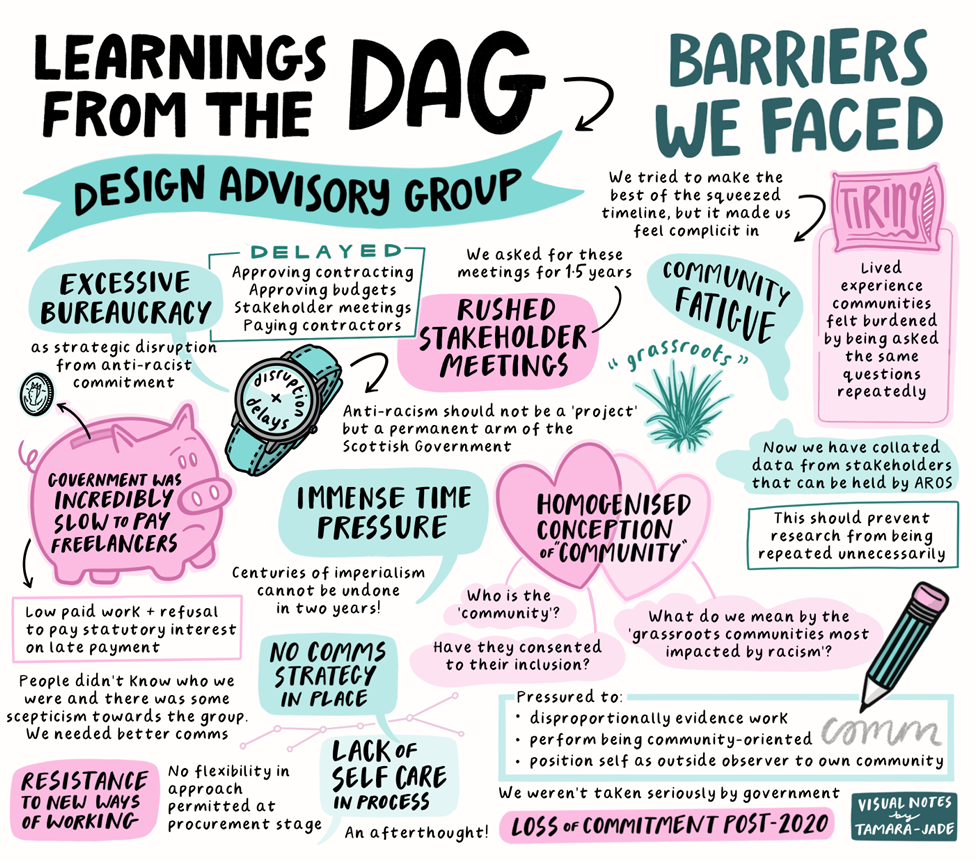
- 2024/12: Learnings From the DAG – Visual Note
- 2024/12: Scottish Government held Stakeholder Events
DAG – Links
DAG – Summary of Minutes
Link | Description |
|---|---|
| 2023/12: Design Advisory Group Minutes | Context & Purpose Meeting held to build connections ahead of the formal Design Advisory Group (DAG) convening in early 2024. Aim: discuss objectives, ways of working, and planning for the next nine months. Members include both long-term participants (from Anti-Racism Interim Governance Group – AIGG) and new joiners. Key Discussions Background & Onboarding Importance of pre-reading AIGG reports (Summary, Vision/Mission, Inception methods). Small group sessions offered to help new members get up to speed. Structure & Modelling of Work DAG work will be organised through Short Life Working Groups (SLWGs) to use members’ expertise effectively. Members encouraged to participate flexibly, according to capacity. Community & Youth Engagement Exploration of how best to bring in community voices, especially young people. Emphasis on an intersectional approach in all DAG activities. Anti-Racism Processes Recognition that designing anti-racism processes for a future organisation requires DAG to model anti-racism in its own operations. Work Planning Building a nine-month workplan, drawing on AIGG groundwork and members’ perspectives. Timeline to be formalised in February 2024. Procurement & Hosting Discussion of Scottish Government (SG) procurement process to establish a host organisation. SLWG to be set up to support this work. Scottish Government Engagement Consideration of SG’s proposed Anti-Racism Strategy and future relationship with the Race Equality Framework (REF). Importance of supporting SG’s engagement with national and wider stakeholders to ensure accurate information sharing. Logistics Agreement on scheduling formal DAG meetings from January 2024. Another preparatory meeting proposed for January. Agreed Actions Draft a “way of working” document embedding anti-racism principles. Form a SLWG for procurement support. Liaise with SG on resourcing and staffing needs. Develop a 6–9 month workplan. |
| 2024/01: Design Advisory Group Minutes | Summary of Key Discussion Points Meeting context: No secretariat support → documents and links unavailable. Programme of work development: Built on 7 strands from the Anti-Racism Interim Governance Group (AIGG). Aim: agree realistic priorities for the 6–9 month interim phase. Proposed focus areas: Community participation and communications for the future Anti-Racism Observatory for Scotland (AROS). Stakeholder engagement and shared definitions of anti-racism. Technical support for repository/digital library design. Influencing procurement processes (design, assessment, participation). Clear briefings on subgroups (procurement, community engagement, stakeholders, repository/data). Development of job descriptions and MoU for future AROS. Learning from external partners (e.g., Wales, Canada, England). Addressing staffing challenges. Further discussions: Building solidarity across organisations. Tackling hostility in the anti-racism/equality landscape while safeguarding communities and members. Strengthening procurement processes to embed anti-racism perspectives. Ensuring a legally strong MoU with the future host. Setting up a short-life working group (SLWG) for community engagement. Planning for scenarios with no identified host organisation. Maintaining AIGG–DAG links despite shifted timelines. Requesting SG’s definition of anti-racism; group to define AR at multiple levels (personal → societal). Budget discussion: Original AIGG costings (2022) outdated; new budget required. Funding must cover: community participation, fiscal host, management capacity, accessibility, and evolving DAG priorities. Interim budget to be refined as priorities are set. Actions agreed: Email SG: need dedicated project manager (current model with seconded staff not working). Outline likely SLWGs and participation opportunities (procurement, community engagement, repository/data). Establish procurement SLWG immediately to respond to SG by end of January. Circulate 6-month meeting schedule to DAG members. |
| 2024/02: Design Advisory Group Minutes | Summary: This was one of the earlier meetings of the DAG. Discussions centred on clarifying the scope and purpose of the Observatory (AROS), and how it would relate to existing structures like the Race Equality Framework and other governmental or community bodies. They examined how lived experience of racism should feed into design choices, what governance might look like, and possible funding / resource needs. Key Points / Action Items: Need for clarity about what the Observatory will not do, to avoid overlap with existing bodies. Early work on identifying possible host organisation(s) underway. Community engagement and how to pay people for their contributions was raised. |
| 2024/03: Design Advisory Group Minutes | Summary: This meeting built on the February discussions. The group refined ideas around accountability, inclusion, and decision-making. There was also more detailed discussion of how to gather evidence and data, what indicators or metrics might be used, and how to ensure reports are meaningful and accessible. Key Points / Action Items: To develop proposals for how AROS will report outcomes, including what metrics will be used. To map existing data sources and gaps, especially relating to race / ethnicity, intersectionality, and geographic variation. Consideration of how to structure leadership / advisory roles (who is involved, terms, representation). |
| 2024/04: Design Advisory Group Minutes | Summary: By April, the DAG was discussing in more depth how engagement with communities should be organised: methods, timing, and ensuring accessibility. There was consideration of the operational model (staffing, host, funding duration), and what kind of outputs might be possible in short / medium term. There was also discussion of risk – e.g. of tokenism, of not achieving trust, of missing voices. Key Points / Action Items: To produce a community engagement plan: who, how, scheduling, and how to use feedback. To draft a model for the Observatory’s structure: host, leadership, oversight. To identify potential risks and mitigation strategies, particularly in relation to community trust, inclusivity, and representation. |
| 2024/05: Design Advisory Group Minutes | DAG Operations: Welcomed new members. Ongoing issues with delayed payments to members. Procurement: Tender notice issued; supplier event scheduled for 17th. Short Life Working Group (SLWG) to design evaluation processes (May–June). MOU draft to be developed between government, host organisation, and AROS. Platforms & Communication: Huddle deemed costly; SG seeking advice on Google Workspace. Core Briefing being prepared to support SG communications about AROS. Requests for timely sharing of FOIs and parliamentary questions. Government Updates: Leadership changes (First Minister, Cabinet, SG liaisons) causing delays. New Equalities Directorate Director (John Somers). Ongoing need for stronger SG collaboration on anti-racism work. Fiscal Host (IFP): Progress made; IFP’s experience with progressive fund management seen as positive. Programme of Work: Members invited to provide input. Issues raised around communication, partnerships, and mapping of SG departments. Risks & Delays: Concern about SG delays in engaging wider race equality stakeholders. Lack of ministerial appointments creating risks and information gaps. Community Engagement: Focus narrowed due to time pressures. Aim to build trust and introduce working principles. Concerns about rushed processes risking harm or perpetuating racism. Equality Impact Assessment (EQIA): Progress overview given. Lack of project lead continues to pose risks and excessive demands on DAG members. Follow-ups: Further requests made for SG stakeholder meeting in race equality sector. Agreed Actions PM to gather and incorporate DAG feedback into Programme of Work (PoW). PM to share list of community organisations securely. Designer pack to be created for community engagement. MOU for future host, DAG, and SG to be drafted. Communications pack to be developed. PDL to draft EQIA briefing. DAG members to suggest external experts to involve. PDL & PM to create: A short summary paragraph of DAG’s role for members to share. A glossary of terms and acronyms for clarity and accessibility. |
| 2024/06: Design Advisory Group Minutes | Summary: This meeting showed movement from high-level design to more practical details. Topics included funding (how much, for how long), recruiting staff / host institution, and structuring governance (e.g. reporting, oversight). The group stressed embedding lived experience of racialised people in all phases of the Observatory’s work. Accessibility and communication were again emphasised (language, format, outreach). Key Points / Action Items: To firm up funding proposals, including cost estimates and what funding will cover. To define host institution options, what capacities are needed, and how they will be selected. Pay, support and logistics for community participants to be built in from the start. |
| 2024/08/01: Design Advisory Group Minutes | Summary: By August the DAG was focusing on models for accountability, how to monitor impact, how to make sure decision-making is transparent and participatory. There were also discussions about the timeline for launching the Observatory, priority themes or issues to address initially, and how to engage with marginalised or hard-to-reach communities. Key Points / Action Items: To develop a proposal for accountability mechanisms: what oversight, how reports are shared, how communities hold AROS to account. To identify priority thematic areas for first projects / data gathering. To ensure communication / outreach strategy, especially for marginalised communities. |
| 2024/08/28: Design Advisory Group Minutes | Summary: At this stage, more detailed design decisions are being mooted. The DAG looked at models from other observatories or similar bodies, what works / doesn’t. They also spent time thinking about sustainability (how the Observatory can keep working beyond initial set-up), staffing, resource needs, and how to balance academic rigour with community relevance. Key Points / Action Items: To review other observatory / oversight models to learn lessons. To draft proposals for staffing structure, roles, skills needed. To plan for sustainable funding beyond initial years. |
| 2024/09: Design Advisory Group Minutes | Summary: Discussion in September turned to draft design proposals (governance, structure) and feedback from earlier engagements. The DAG assessed what has been working / what needs change, especially around participation, accessibility, and data. Also, emphasis was placed on ensuring outputs are actionable, that reporting is not just descriptive but leads to recommendations and change. Key Points / Action Items: To finalise draft structure proposals including roles, decision-making pathways. To refine metrics / indicators: what will be measured, how, who will do the measuring. To improve feedback loops from community engagement into decision-making processes. |
| 2024/11: Design Advisory Group Minutes | Summary: By November the DAG was reviewing near-final proposals for how the Observatory will operate. Items included host organisation selection, staffing, budget, reporting, accountability, and how to ensure community oversight. Also, what initial outputs might be: research questions, data collection, publications. There was consideration of how to embed equity, to ensure marginalised voices are centred, and avoid bureaucratic or academic capture. Key Points / Action Items: Review / select host organisation and leadership roles. Present a budgeted plan for the first 18-24 months of operation. Plan the first research / data priorities (topics, geographies, groups) so that early work is meaningful. |
| 2024/12: Design Advisory Group Minutes | Summary: The group reviewed what had been agreed, and checked progress vs. earlier action items. They focused on refining operational detail: governance, data / evidence, community participation, communications. Also discussed were risks (funding continuity, representation, data quality), and what to do to ensure strong visibility and impact from the start. Key Points / Action Items: • To confirm governance framework including oversight, advisory boards / committees, and community-led input. To finalise the metrics and reporting schedule. To ensure communications / public launch plans are in place with clarity of purpose, how AROS will engage, what the public / stakeholders can expect. |
