
4c. AROS’ Governance & Structure
Organisational Structure
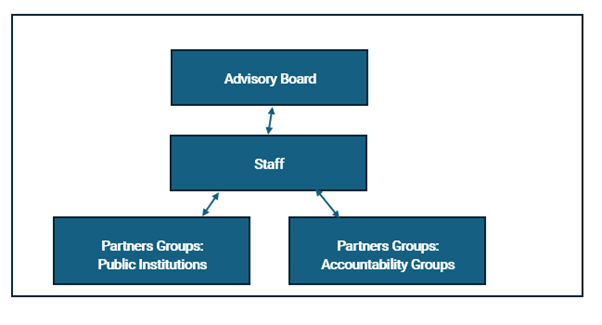
The Advisory Board
The AROS will advertise publicly for members of its advisory board and recruit them through a full and open process. We will look for a range of expertise.
AROS is particularly keen to hear from people with experience in the creative industry, finance, governance, research and academia, and the legal sector. We will also keep two spaces for community or grassroots applicants and a further two for young people.
AROS will follow best practice when it comes to defining “young”, as all AROS members must be aged 16 or over. We expect that a lot of the work of the advisory board in its first two years will be co-designing and setting up the AROS.
The advisory board will meet every two months, and at other times where needed. At the very least, half of its members +1 must be at every meeting (this is what is known as a quorum)(AIGG, 2023a).
IYS has agreed to work with us to find the best way of recruiting and supporting young people. AROS is keen that young people do not feel excluded or that they are there just for the sake of appearances.
How the advisory board will work
- AROS expects the co-CEOs to develop the advisory board’s remit once they are in place, with advice from the Scottish Government and legal experts.
- In its first year the board will have 13 members.
- The advisory board will be made up of individuals only.
- All 13 will have voting rights on how the AROS is run as well as on legal and financial matters.
- All minutes of its meetings will be made public.
- No person shall be able to be chair of the board for more than three years in a row.
- In the future, new members will be voted onto the board. These votes will take place at an annual general meeting (AGM).
- To sign off the AROS annual accounts, two-thirds of its board members must be there to do so at its AGM.
The AIGG suggested a day rate of £200, for no more than two days of work per month, for all members. That puts the highest possible payment at £4,800 per year, for attending meetings, pre-meeting work, doing meeting minutes, and so on. We will review this annually to make sure it stays in line with the cost of living.
If any member takes on further work on behalf of the AROS (where all members agree and there are no conflicts of interest), we will pay them at the going rate.
Staff
The agreed structure and Model document (AIGG, 2023a) stated that in the first year, AROS will recruit staff to work in the following areas:
- Chief Executive Office (Co-CEOs)
- Community outreach and participation
- Policy
- Data and accountability
- Communications
- Repository platform development (technical role)
- Administration
- Apprenticeship roles
Partner Groups
We will ask the following public institutions to put forward a senior member of their staff for this group: —
- Scottish Government
- Equality and Human Rights Commission (EHRC)
- Scottish Human Rights Commission (SHRC)
- Public Health Scotland
- Convention of Scottish Local Authorities (COSLA)
- Presiding officer/Executive member of Parliament staff
- Others, as identified
The group’s purpose will be to help public institutions become anti-racist. Its members will also work with us to develop ways of holding public institutions to account for their progress on becoming anti-racist. The group will meet three times a year. It will also take part in an annual accountability exercise to see what progress public institutions are making on anti-racism (AIGG, 2023a)
Accountability Groups
This group will be made up of a range of community organisations and grassroots groups (they do not need to be formally recognised groups as such). It will also include experts on relevant subjects with lived experience of racial inequity. The purpose of the group will be to help shape both the AROS’s long-term goals and how it will go about them; hold us to account for reaching those goals; and, serve as another link between the AROS and communities. The group will meet at least four times a year. Along with AROS staff, it will co-produce the annual accountability exercise.
Structure & Model Document (Approved by Ministers)
Powered By EmbedPress
